Javascriptfordatascience.Com
2026-06-05
JavaScript, Data Science, Web development
3 minutes

Disclaimer: All content on this website, including all code examples, is created and written by me. No AI tools were used in the creation of any content on this site.
An overview of what we’ll be discussing in this article
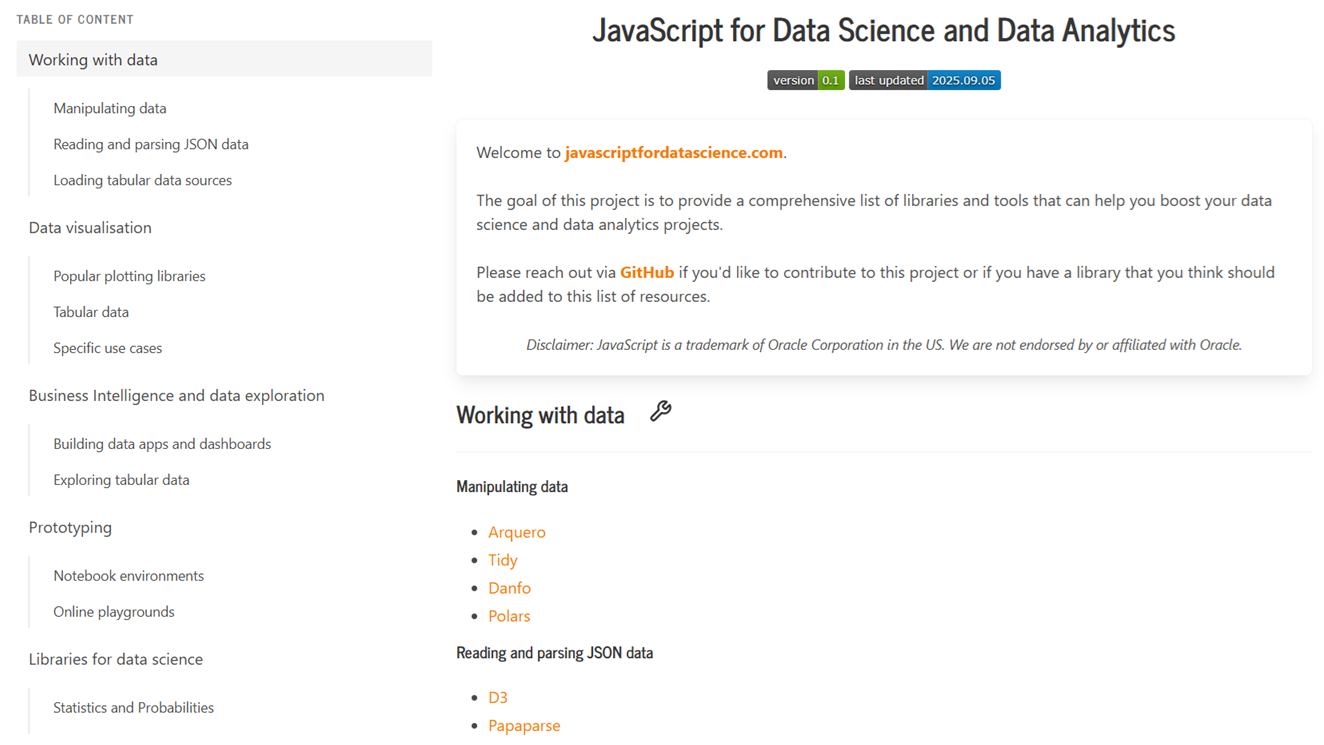
One of my main objectives when I started this blog back in 2020 was to share any interesting data-oriented library or framework that I would come across.
Almost six years later, I've come to realise that this approach leaves a lot to be desired. One of the main issues is that as of today, it is still not possible to filter posts by tags, or to search for articles that contain a specific keyword. Unfortunately, this means that some of the posts that I wrote months ago are now buried under dozens or so of more recent entries (yes, I'm exaggerating). Now let's be honest, I won't pretend that I get hundreds of thousands of visitors each week. That being said, I also write for myself. I want to be able to easily find some of the code that I've written on this website and reuse it when starting a new project.
The truth is, I've been a bit busy working on a couple of personal projects lately, and I unfortunately haven't had a chance to implement these functionalities into Loulou, my static site generator.
I was therefore quite excited when about a year ago, I finally managed to purchase a domain name that I had had my eyes on for a while. I indeed became the proud owner of JavascriptForDataScience.com in late 2024, and felt that this would be the perfect opportunity to build a more simple and yet much more useful portal for anybody that wants to learn something different.
As discussed a good number of times on this website, JavaScript is a fantastic second language for anybody that works in the field of data.
Now I am very much aware that there is at least one issue with this statement: it reduces JavaScript to something that can only be used to perform optional, non data-related tasks. Like for instance to build a web application, or some interactive reporting tool.
Well that used to be true up until a few years ago. But today, you can for instance easily perform some pretty advanced data manipulation using JavaScript, like you would with Pandas or Dplyr. Of course, you might not find a data wrangling libraries that's as powerful as its Python or R counterpart. But packages like Arquero or TidyJS to name a few will get you covered in 99% of cases, and might even be more intuitive to use.
Now add to this some of the best visualisation frameworks around, and you'll easily understand why I've been so keen on promoting a language that I think isn't appreciated as it should be by the data community. Sure even TensorFlow now supports JavaScript!
Over the past few years, we've explored quite a few interesting data-related packages on this blog. All of which can be installed locally via Node (though I would highly recommend you use Bun instead). Some can run directly in your favourite browser:
Actually, we even reviewed a book entitled JavaScript for Data Science!
Now unsurprisingly, these articles formed the basis of the first iteration of the website that we are discussing today, which I think went live in early 2025.
Fundamentally, JavascriptForDataScience.com is just a curated list of npm packages. To be a bit more specific, opening this url redirects to a GitHub Pages website that is associated with my personal repository. What this means is that anybody can suggest changes to the overall layout, add new packages, new sections, etc..
And yes, JavascriptForDataScience.com is just a single webpage. I used Bulma as the main CSS framework and the Journal theme from Bulmaswatch.
Now here's the overarching idea: whenever I stumble upon a data-related package that I think could be useful, I simply add it to the repo. It's as simple as that. And as a matter of fact, the table of contents is now pretty close to those you'll find in any popular data anlytics or data science book:
Working with data
    Manipulating data
    Reading and parsing JSON data
    Loading tabular data sources
Data visualisation
    Popular plotting libraries
    Tabular data
    Specific use cases
Business Intelligence and data exploration
    Building data apps and dashboards
    Exploring tabular data
Prototyping
    Notebook environments
    Online playgrounds
Libraries for data science
    Statistics and Probabilities
    Machine Learning
    Natural language processing
    Deep learning
Basics of web development for data practitioners
    Make your webpages prettier
    Static site generators
    Hosting solutions
    Creating a web server
    Web application frameworks
Further reading
    Books
    Tutorials
    Data science
    Web development
Oh one last thing I should mention: this website is free, and will always be. No ads, no paid courses.
Now you might wonder, why would anybody that owns this domain name decide to let go of it? A rapid search on Amazon shows that a good fews books that tackle the same topic have recently been published or are about to be:
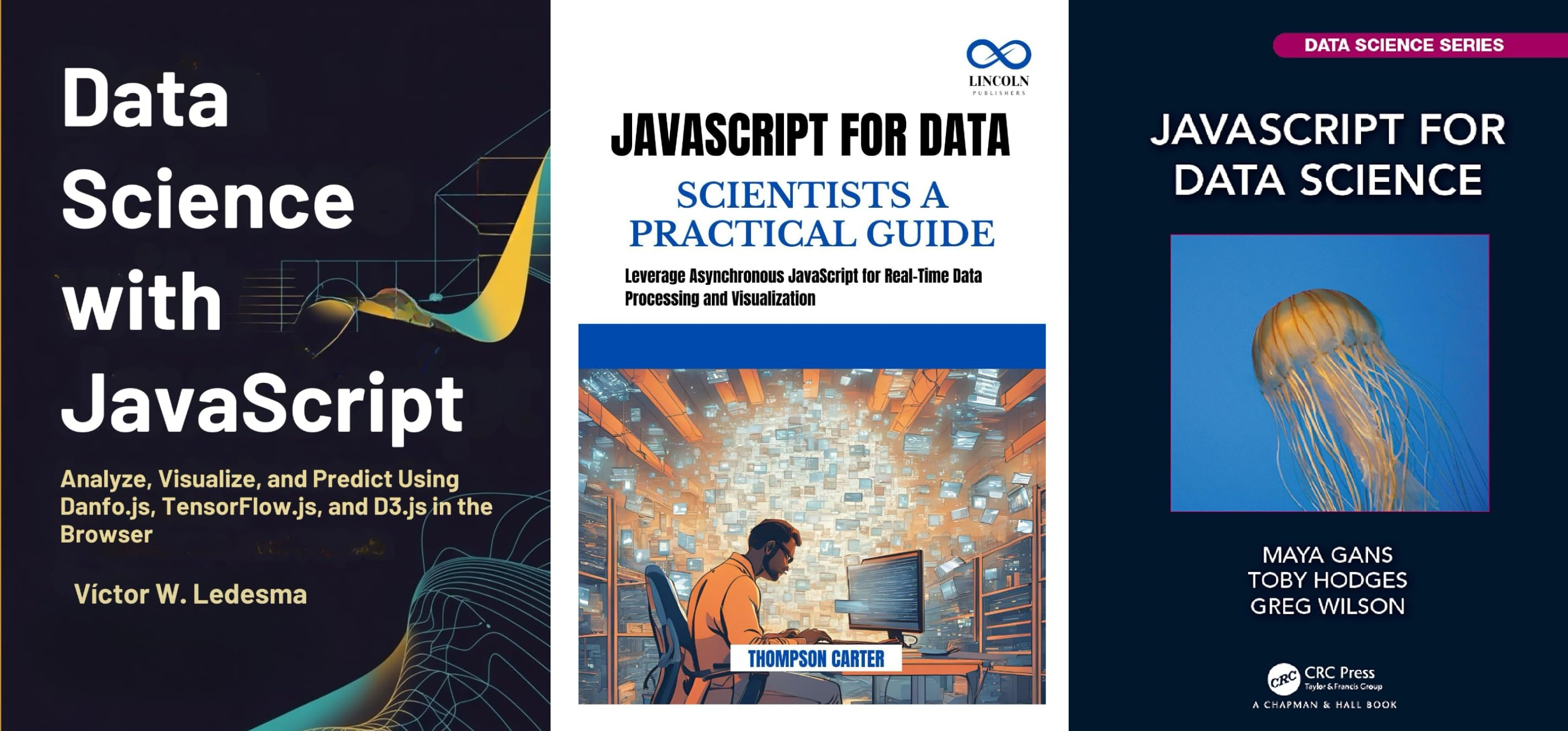
The answer is that, well, I really don't know. That being said, perhaps that using a website to promote a book (or a movie, etc..) is not as popular these days as it used to. But really, that's just an uneducated guess and I'm probably wrong.
I should also mention that there is unfortunately a tiny, tiny chance that whoever owned this domain name had no choice but to let go of it. Now I really don't want to jinx myself, and anyway I'm even smaller than a very small fish in a very large ocean. But as Bryan Cantrill said in his legendary speech, "don't anthropomorphize the lawnmower"!
So what's next? Well for once I'm going to continue adding any interesting data-related package that I stumble upon. I usually discover these via Hacker News, or when watching YouTube videos.
If you know of a project that you think should be featured on JavascriptForDataScience.com, either add it to the repo, or just reach out to me directly.
Thanks, and see you next time!